Friday, November 2, 2007

First Chimp to Sign Dies


A female chimpanzee believed to be the first nonhuman to acquire human language has died of natural causes at the Washington State research institute where she was kept.

Washoe, who first learned a bit of American Sign Language during a research project in Nevada, had been living on Central Washington University's Ellensburg campus since 1980. She had a vocabulary of about 250 words.

She died Tuesday night, according to Roger and Deborah Fouts, co-founders of The Chimpanzee and Human Communications Institute (CHCI) on the campus.

Washoe was born in Africa in about 1965.

She was taken to the veterinary hospital at Washington State University on Wednesday for a necropsy.

Her memorial will be on November 12.

The Fouts went to Central Washington from Oklahoma in 1980 to create a home for Washoe and other chimps.

"The entire CWU community and the Ellensburg community are feeling the loss of our friend, Washoe, one of our daughters," said CWU President Jerilyn S. McIntyre.

Washoe also taught sign language to three younger chimps who remain at the institute, university spokesperson Becky Watson said. They are Tatu, 31; Loulis, 29; and Dar, 31.

Washoe was named for Washoe County, Nevada, where she lived with Allen and Beatrix Gardner of the University of Nevada, Reno, from 1966 to 1970.

Monkey Babysitter!

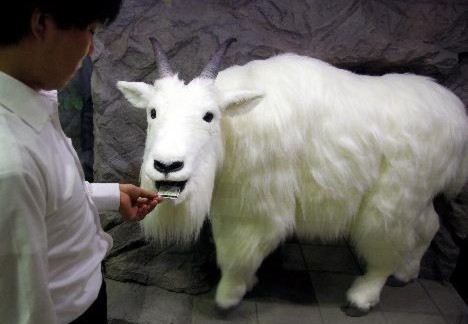
Please do not milk the Robot Goat


Unlucky gamblers at the Edogawa Kyotei boat race course in Tokyo have a new way to ease their frustrations after botching a bet — they can feed their losing tickets to a robotic goat. Edogawa Kyotei enlisted the help of the ticket-munching robo-goat at the end of last month in an effort to reduce litter inside the facility. The 1.6-meter tall Rocky Mountain goat, which has a thick coat of white fur and ticket-detecting sensors in its mouth, devours about 500 tickets per day — many of which would otherwise end up on the floor. The goatkeeper says, “It eats up your frustrations so that you will have better luck with the next race.”

Woman Says Dog Saved Her by Performing Heimlich Maneuver


Debbie Parkhurst, a 45-year-old jewelry artist who lives in Calvert, Md., says her dog Toby saved her life last week after she began to choke on a piece of apple by giving her the Heimlich maneuver, the Cecil Whig reported.

Parkhurst was home alone Friday afternoon eating a snack of sliced apples when one became lodged in her windpipe. After smacking herself against a chair to dislodge it, she started beating herself on the chest, which she thinks alerted Toby to the problem.

"The next think I know, Toby’s up on his hind feet and he’s got his front paws on my shoulders," she told the Cecil Whig. "He pushed me to the ground, and once I was on my back, he began jumping up and down on my chest."

The apple eventually became loose and Toby started licking her face, possibly to keep her from passing out, Parkhurst said.

"I, literally, have pawprint-shaped bruises on my chest," Parkhurst said. "I’m still a little hoarse, but otherwise, I’m OK."

A friend took Parkhurst to the doctor.

"The doctor said I probably wouldn’t be here without Toby," the married woman and owner of two dogs said. "I keep looking at him and saying ‘You’re amazing.’"

Thursday, November 1, 2007

LOLcat for the Bloggers


Care of a pony friend of mine.

Squirrel Finds New BFF!

Do Black Cats Cause Bad Luck?


What is superstition? According to The Little Oxford Dictionary, superstition is "belief in the existence or power of the supernatural; irrational fear of the unknown; a religion or practice based on such tendencies; widely held but wrong idea." Let us examine that definition in depth. First, there is "belief in the existence or power of the supernatural". This means that there is believed to be some force that can influence the events on the Earth. Second, there is "irrational fear of the unknown." This has been endemic to the human race since the early days when a cave man did not know if that cave was safe to enter or if he would be attacked by a bear. Third, "a religion or practice based on such tendencies." This is the belief that a charm or talisman, such as throwing salt or hanging a horseshoe over the doorway, can affect the aforementioned supernatural force. Finally, there is a "widely held but wrong idea." This is a belief that is believed only because everyone else believes. It may be wrong, it may be preposterous, but all the other people think it is right and you believe it too.

Some examples of common, everyday superstition include the belief that the number 13 is unlucky, that walking under a ladder will bring bad luck, and that a black cat crossing your path can affect your luck. Belief that black cats affect your luck goes far back in time. One king of England, Charles I, owned a black cat. His fear of losing it was so great that he had it guarded. The day after it fell ill and died, he was arrested (Radford 1949, 40). Black cats were often witches in disguise or witches' familiars (Potter 1983, 29). There were also many cat charms relating to ships and the sea. Fishermen's wives would keep a black cat at home to prevent disaster at sea, consequently the cats became very valuable and were often stolen. If a cat ran ahead of a sailor to the pier that would bring good luck, but if the cat crossed his path it means bad luck. For luck, cats were often kept on board ships. If a sailor was approached by the ship's cat it meant good luck, but if the cat only came halfway and went away again it meant bad luck. The worst possible cat-related act, guaranteed to raise a storm and bring bad luck of all sorts, was to throw the cat overboard (Radford 1949, 40). Cat superstitions were also common in medicine. Fur and blood drawn from various parts of the cat's anatomy cured everything from shingles to St. Anthony's Fire (Radford 1949, 40).

All of these superstitions today boil down to "Black cats cause bad luck." A cat crossing your path will adversely affect your luck. This can easily be verified or dis-proven with only a person, a cat, and a situation that can be affected by luck.

Full Story

LOLtiger

funny pictures
moarfunny pictures

Dog fights for life after saving owner from snake


An Australian sheepdog is fighting for its life after being bitten while saving its owner from a huge and deadly snake, local media reported Wednesday.

Fay Palethorpe, 68, was gardening on her large Gold Coast property when she encountered a two-metre (six-foot) eastern brown snake, the Australian Associated Press reported.

"He saw me and I saw him, and he reared up about two foot into the air and struck at me three times," she said. "I just screamed and ran."

As the snake pursued Palethorpe across the garden her three Australian sheepdogs, known as kelpies, leapt to her defence.

"It was coming after me, chasing me," she said, describing how one of the dogs, Tess, grabbed the snake and threw it in the air before it fled.

But the dog was bitten on the ear and was bleeding internally by the time Palethorpe reached an emergency animal clinic where Tess was given an urgent dose of antivenene.

"My vet said if it had got me I wouldn't have reached my back stairs, it was so deadly," Palethorpe said.

Tess sank into a coma soon after the incident on Sunday, and the vet rated her chances of survival as 50-50. But the heroic pet began blinking her eyes on Wednesday.

"Every hour is a little bit better," said Palethorpe.

Why do so many species live in tropical forests and coral reefs?


The latest development in a major debate over a controversial hypothesis of biodiversity and species abundance is the subject of a paper would be reported in the 1 November 2007 issue of the journal Nature. The authors report good agreement between the species richness of two of the world's most vulnerable ecosystems -- tropical forests and coral reefs -- and a simple mathematical model building on the so-called "neutral theory of biodiversity." "We're helping to refine and improve this theory because it might have important implications for the effort to protect terrestrial biodiversity from climate change and urban development," says Jayanth Banavar of the Department of Physics at Penn State, a member of the research team.

The Nature paper is based on a counterintuitive assumption of neutral theory: that one can largely ignore interactions between species in modeling patterns of species abundance. The authors are physicists Igor Volkov and Jayanth Banavar of Penn State University, plant biologist Stephen Hubbell of UCLA (formerly of the University of Georgia), and physicist Amos Maritan of the University of Padua in Italy.

Among ecological theorists, neutral theory has sparked a six-year quarrel over the fundamental assumptions of their discipline. The Nature paper counters another scientific team's claim in 2006 that coral-reef diversity "refutes" the neutral theory. At the same time, the paper by Volkov et al., would be published on 1 November 2007, modifies the classical version of neutral theory that appeared in a 2001 book by Hubbell. (Graham Bell of McGill University also developed a neutral theory independently of Hubbell.) Banavar, Maritan, Volkov, and their collaborators have been active in the development of a mathematical framework for understanding ecosystems that builds on and clarifies Hubbell's neutral theory...
Full Story

Partial Cat Genome Sequenced, May Aid Human Medicine


The first "rough draft" genome for the domestic cat has been sequenced by an international team of scientists.

The new sequence is based on the DNA of a four-year-old Abyssinian named Cinnamon, a purebred cat whose lineage can be traced for several generations.

The female animal yielded about 65 percent of the cat genome, which is now thought to contain 20,285 genes. By contrast, the human genome is believed to hold between 20,000 and 25,000 genes.

"[Cinnamon] 'volunteered' to have her genome sequenced so that we could understand [more about] the details of what makes a cat a cat," said study co-author Stephen O'Brien of the National Cancer Institute's Laboratory of Genomic Diversity in Frederick, Maryland.

Wednesday, October 31, 2007

Tuesday, October 30, 2007

Corgis, Almost as Powerful as Gays


Corgi's dominated the 1st annual Fido awards, held in conjunction with the London International Film Festival on Sunday night. They won two out of five categories, including Best Historical Hound and Best Comedy Canine. One breed hasn't dominated the theatre industry like this in... oh wait...

Dog iPhone


For halloween this year, i am dressing up as an iPhone.
It looks like this dog had the same idea!

Monday, October 29, 2007

Love, Or Something Like It


You know when your trying to do research on the internet -- say, hypothetically, on the sexual escapades of Blue Footed Boobies -- and all you can find is the same limited details, and everywhere you find them they're worded in such a strikingly similar manner that you can't help but think that the internet is more incestuous than the Hapsburgs and that eventually all recorded human knowledge will have originated one night out of the keyboard imaginings of a geeky eight-year-old whose parents still have him sheltered from porn? It'll all just be writ from above like the days of Moses.
And in this grand tradition, we bring you the mating habits of the Blue Footed Booby!
Blue-footed boobies have an elaborate courtship ritual that entertains onlookers. Once a male booby has chosen a mating spot, he repeatedly raises his beak into the air in a motion called "skypointing," to signal his readiness to females. The attracted female joins him, mirroring the skypointing, and he begins to circle her with high steps, flexing and extending his wings. During this dramatic dance one of the birds will place a stick or stone onto the ground, indicating the spot designated for nesting. Nests are located close to shore and are often seen by passing tour boats.
Skypointing. Yeah, I guess we kind of do that too.