Wednesday, April 30, 2008

Fence porthole gives pooch a point of view

It needs no explanation, the Pets' Observation Poodle from Hammacher Schlemmer. Nine inches wide and 5" deep, it gives "the inquisitive canine," which is cataloguese for "dog," a panoramic view of things at which to bark.

Hammacher Schlemmer suggests lining several of these $30 domes around the perimeter of your yard, to allow your pet an unrestricted view of interesting places it cannot go.

Source: Boing Boing Gadgets

Friday, April 25, 2008

Drug-Sniffing Dogs Cloned in Korea

The Korean Customs Service today unveiled seven golden Labrador retrievers cloned from a skilled drug-sniffing canine in active service—a test to see if duplicates could reduce the difficulty and expense of finding dogs qualified to detect drugs and explosives, officials say.

Seen here at their training facility near Incheon International Airport west of Seoul, the pups were born five to six months ago.

The dogs all currently share the same name: "Toppy"—a portmanteau of the words "tomorrow" and "puppy."

In February all seven passed a behavior test to check if they are qualified to work as sniffing dogs. Only 10 to 15 percent of naturally born dogs pass the test.

If the cloned dogs succeed in other tests for physical strength, concentration, and sniffing ability, they will be put to work by July 2009 at airports and harbors across South Korea, according to the training center.

Normally, only about three out every ten naturally born dogs the center trains—at a cost of about $40,140 each—ends up qualifying for the job.

The cloning was conducted by the team at Seoul National University that in 2005 successfully created the first known dog clone, an Afghan hound named Snuppy.

The team's leader, Lee Byeong-chun, was a key aide to disgraced scientist Hwang Woo-suk. Hwang's purported breakthroughs in stem cell research were revealed as false, but independent tests proved the team's dog cloning was genuine.

Lee said it cost approximately $100,000 to $150,000 to clone each of the seven Labradors.

The seven are the first cloned drug-sniffing dogs, though his team has cloned 13 other dogs and five wolves, he added.

Ancient Praying Mantis Found in Amber...

An 87-million-year-old praying mantis found encased in amber in Japan may be a "missing link" between mantises from the Cretaceous period and modern-day insects.

The fossil mantis measures 0.5 inch (1.4 centimeters) from its antennae to the tip of its abdomen.

Although the forelegs, head, and antennae appear to be well preserved, the wings and abdomen have been badly crushed.

Kazuhisa Sasaki, director of the Kuji Amber Museum, found the fossil creature in January buried 6.5 feet (2 meters) below the surface in an amber mine in Japan's northeastern Iwate Prefecture.

"This part of Japan is famous for producing large amounts of amber, but it was very fortunate for me to find this specimen," Sasaki said.

"I found it in a deposit that had lots of other insects—ancient flies, bees, and cockroaches—but this was the only praying mantis."

Are animals stuck in time?

Dog owners, who have noticed that their four-legged friend seem equally delighted to see them after five minutes away as five hours, may wonder if animals can tell when time passes. Newly published research from The University of Western Ontario may bring us closer to answering that very question.

The results of the research, entitled "Episodic-Like Memory in Rats: Is it Based on When or How Long Ago," appear in the current issue of the journal Science, which was released recently.

William Roberts and colleagues in Western's Psychology Department observed that rats are able to keep track of how much time has passed since they discovered a piece of cheese, be it a little or a lot, but they don't actually form memories of when the discovery occurred. That is, the rats can't place the memories in time.

The research team, led by Roberts, designed an experiment in which rats visited the 'arms' of a maze at different times of day. Some arms contained moderately desirable food pellets, and one arm contained a highly desirable piece of cheese. Rats were later returned to the maze with the cheese removed on certain trials and with the cheese replaced with a pellet on others.

All told, three groups of rats were tested in the research using three varying cues: when, how long ago or when plus how long ago.

Only the cue of how long ago food was encountered was used successfully by the rats.

These results, the scientists say, suggest that episodic-like memory in rats is qualitatively different from human episodic memory, which involves retention of the point in past time when an event occurred.

""The rats remember whether they did something, such as hoarded food a few hours or five days ago," explained Roberts. "The more time that has passed, the weaker the memory may be. Rats may learn to follow different courses of action using weak and strong memory traces as cues, thus responding differently depending on how long ago an event occurred. However, they do not remember that the event occurred at a specific point in past time." .

Prior studies have suggested that rats and scrub jays (a relative of the crow and the blue jay) appear to remember storing or discovering various foods, but it hasn't been clear whether the animals were remembering exactly when these events happened or how much time had elapsed.

"This research," said Roberts, "supports the theory I introduced that animals are stuck in time, with no sense of time extending into the past or future."

Are Ice Age relics the next casualty of climate change?

The Wildlife Conservation Society (WCS) recently launched a four-year study to determine if climate change is affecting populations of a quintessential Arctic denizen: the rare musk ox. Along with collaborators from the National Park Service, U. S. Geological Survey, and Alaska Fish and Game, Wildlife Conservation Society scientists have already equipped six musk ox with GPS collars to better understand how climate change may affect these relics of the Pleistocene.

The research team will be assessing how musk ox are faring in areas along the Chukchi and northern Bering Seas, and the extent to which snow and icing events, disease, and possibly predation may be driving populations.

Musk ox are a throwback to our Pleistocene heritage and once shared the landscape with mammoths, wild horses, and sabered cats, said the studys leader Dr. Joel Berger, a Wildlife Conservation Society scientist and professor at the University of Montana. They may also help researchers understand how arctic species can or cannot adapt to climate change.

Once found in Europe and Northern Asia, today musk ox are restricted to Arctic regions in North America and Greenland eventhough they have been introduced into Russia and northern Europe. They have been reintroduced in Alaska after being wiped out in the late 19th century. Currently they found in two national parks: Alaskas Bering Land Bridge National Park and Cape Krusenstem National Monument.

Balding Penguin Gets a Wetsuit

Pierre, an African penguin at the California Academy of Sciences, was going bald, which posed a significant problem for the 25-year old bird. Penguins rely on their feathers to stay warm, not blubber.

The poor little bird was shivering and refusing to get into the water. Scientists charged with his care initially tried a heat lamp to keep him warm, but that was costing him social interaction, so they began brainstorming. The result was interesting to say the least. They ordered him a wetsuit.

Pierre, who began going bald when he was five years older than the average life expectancy of a penguin, was fitted for a suit by Oceanic, one of the largest manufacturers of wetsuits in the world.

He has, since that time, began to re-grow his feathers. He now fearlessly plunges into the water where his mates have readily accepted him, allaying one of the early fears of the scientists. Pierre, who has been in the Velcro-closed suit for about six weeks now, is already being weaned off his new clothes as he re-grows his feathers, but until then happily flaps around the habitat with his black neoprene body.

Thursday, April 24, 2008

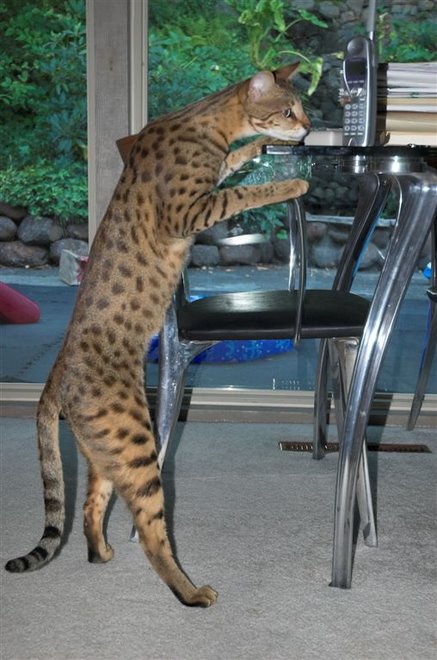
Ashera Cats are expensive...

The ASHERA EXOTIC CAT is considered one of the rarest domestic cat available today. A proprietary blend of the exotic bloodlines of the African Serval and the Asian Leopard Cat subsequently crossed with a rare domestic cat, the ASHERA grows up to 30 pounds (14 kg).

The Snow Ashera is a rare version of the standard Ashera and differs in that the background color is white instead of the brown caramel seen in the standard cat. The result is a striking animal that resembles the famed white tigers. The Royal Ashera is rarer still, with less than four kittens produced each year. The Royal Ashera has a cream background but uniquely, the spots and stripes are tiger orange, instead of black. The Royal Ashera is indeed the rarest domestic cat in the world and will be enjoyed by just a few. All ASHERA kittens are hand delivered to your residence (U.S. residents only).


Price: From $22,000.00 to $130,000.00


LifeStyle Pets

Oscar the sexy naked bird...


Oscar has a rare virus that causes her to pull out her feathers because they irritate her. She has survived 12 years so far. And yes, Oscar is a girl. It was a year before Humane Society workers determined through a blood test that what they thought was male, was truly female, and it was too late to change names.

Wednesday, April 23, 2008

3-D Coyote Lifelike, Full-Size Predator


Get rid of aggressive, destructive, disease-carrying Canada geese

www.bird-x.com

DIY Discovery Channel: Casio EX-F1 Slow-Mo Cam In My Backyard

Shooting slow-mo takes some getting used to, and because you end up with long stretches of zero movement, the in-cam video editor is not just a luxury but a necessity. In the end, though, everything looks like it's ready for Discovery Channel. I think that chipmunk's gonna be a star.

Check out the VIDEO

Compliments of Gizmodo

Tuesday, April 22, 2008

Monday, April 21, 2008